Freedom to Operate (FTO) analysis is a critical step in the product commercialization process. While prior art searches focus on novelty and patentability, FTO focuses on infringement risk-determining whether a product or system may fall within the scope of existing patent claims.
Like the AI-driven prior art workflow, this approach extends similar pipeline to focus on claim-level analysis, enabling organizations to assess legal exposure and make informed go-to-market decisions.
Prior Art Search → Feature-centric (What has been disclosed?): Focuses on identifying whether similar technical features, concepts, or implementations have already been described in existing patents or literature, primarily to assess novelty and patentability.
FTO Analysis → Claim-centric (What is legally protected?): Focuses on interpreting active patent claims to determine the legal scope of protection and whether a product or system may infringe, supporting risk assessment and commercialization decisions.
Business Scenario: Smart Home IoT Hub
Consider a smart home IoT hub with features such as multi-protocol connectivity, edge-AI automation, and voice integration, an FTO flow will be as follows.
After the patents have been analyzed for features, they can be pipelined for FTO search. Additionally, new other patents can be found by using the AI n8n workflow, then the following can be done:
Step 1: Feature-to-Claim Mapping
AI based workflow can analyze the product or system at a technical level and systematically align its core features with corresponding elements found in patent claims. This process goes beyond simple keyword matching by interpreting functional similarities, technical behaviors, and architectural patterns, enabling a more accurate linkage between what the product does and what the patent legally protects.

Illustration of product features mapping to patent claims
Step 2: Claim Parsing and Structuring
Patent claims are processed and decomposed into structured, machine-readable elements such as individual limitations, dependencies, and scope qualifiers. By breaking down complex legal language into organized components, AI enables precise comparison and downstream analysis, making it easier to understand how each part of a claim contributes to the overall protection.

Illustration of AI parsing of patent claims
Step 3: Claim Coverage Analysis
AI evaluates the degree to which product features map to the structured claim elements, determining whether there is a full match, partial overlap, or no correspondence. This analysis helps quantify potential infringement risk by assessing how comprehensively the product falls within the scope of one or more claims, while also highlighting gaps or distinctions that may reduce exposure.
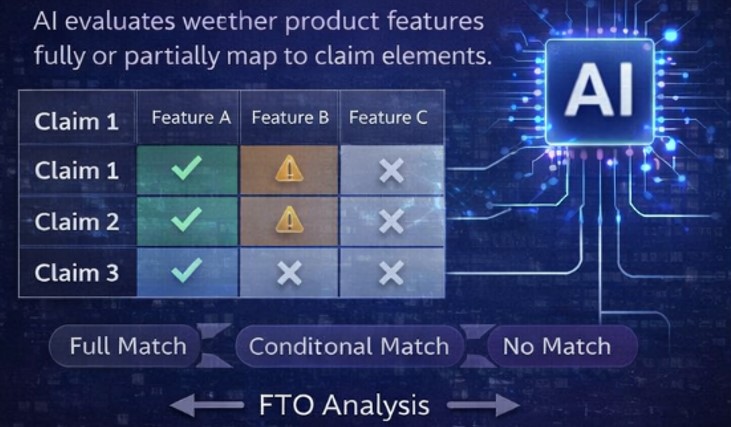
Claim analysis illustration
Step 4: Human-in-the-Loop Legal Review
Patent attorneys and technical experts review the AI-generated mappings and analysis to validate accuracy, interpret claim scope, and assess legal risk in context. This step incorporates professional judgment to refine conclusions, identify design-around opportunities or licensing needs, and ensure that final decisions are grounded in both technical insight and legal expertise.

Human review of AI results
n8n Sample Workflow
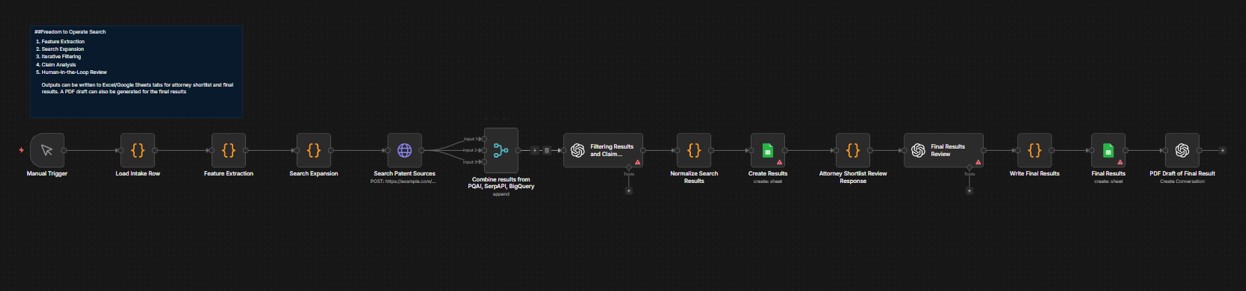
Advantages of an AI-based workflow:
- Faster identification of infringement risks
AI accelerates the analysis of large patent portfolios by quickly mapping product features to claim elements, enabling teams to identify potential infringement risks much earlier in the product development lifecycle and reduce delays in decision-making. - Scalable and consistent claim analysis
The workflow allows organizations to analyze thousands of patents systematically and consistently, overcoming the limitations of manual review while ensuring that claim interpretation and mapping follow a structured and repeatable approach. - Improved collaboration between legal and engineering teams
By translating complex patent claims into structured, feature-level insights, the workflow creates a shared understanding between legal and technical teams, facilitating more effective discussions, faster validation, and better-informed strategic decisions.
Conclusion
By extending AI workflows from feature-based discovery to claim-based analysis, organizations can ensure safer commercialization decisions.
About the Author and Firm
This analysis is provided by Kama Thuo, PLLC, an engineering & technology law firm focused on patents, AI, and wireless telecom law. Brian Kibet is a multidisciplinary professional with expertise in wireless engineering, paralegal practice, and software development. With a strong background in AI and automation, he designs intelligent workflows for intellectual property processes, with a focus on patent-related work, bridging the gap between technical innovation and legal strategy.
Whether you are an inventor seeking to license your technology or a company navigating an IP dispute, our firm has the technical and legal expertise to protect your interests. Reach out to us to see how we can assist you at www.kthlaw.com/patents, or explore our AI-powered legal services at https://www.kthlaw.com/ai.