Artificial intelligence has fundamentally reshaped how prior art and patentability searches are conducted. What was once a labor-intensive, keyword-heavy process is now increasingly driven by semantic understanding, feature extraction, and multimodal analysis. The question is no longer whether to use AI in patent search workflows - but how to use it effectively.
This article explores that question from two angles: the perspective of patent law firms navigating the limitations of existing AI tools, and a practical, do-it-yourself (DIY) approach for patent professionals and innovators using accessible AI technologies.
The Evolving Nature of Prior Art Search
Traditional prior art searches relied heavily on Boolean queries, classification codes (e.g., CPC), and manual review of patent documents. While these methods remain relevant, they are inherently limited by language dependency - missing relevant disclosures that describe similar inventions using different terminology.
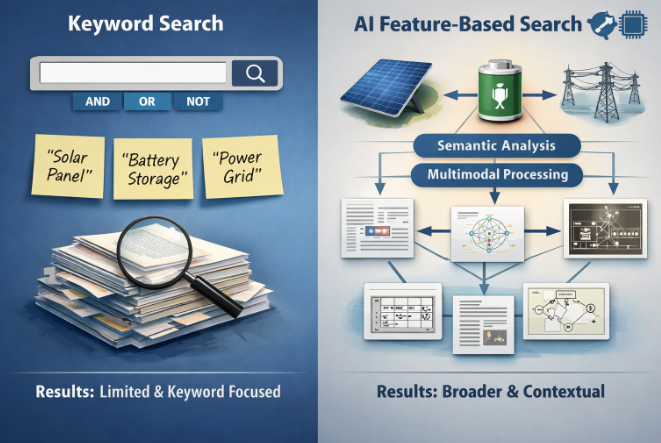
AI-driven search changes the paradigm. Instead of asking, “What keywords match this invention?”, the system instead focuses on identifying the core technical features of an invention, mapping those features across existing disclosures, and uncovering functional or structural equivalence regardless of how something is described. Modern AI systems leverage natural language processing, embeddings, and increasingly computer vision to uncover deeper relationships across patent literature.
keyword search vs AI feature-based search
Limitations of Existing AI Tools from a Patent Law Firm Perspective
Despite rapid advancements, AI tools for patent search still present several limitations that law firms must navigate carefully. One of the most significant challenges is the lack of true legal reasoning. While AI tools are highly effective at retrieving and summarizing technical content, they do not reliably interpret legal standards such as novelty and non-obviousness. These determinations require understanding claim scope, applying legal doctrines, and evaluating how prior art would be interpreted by a patent examiner or court-tasks that still depend heavily on human expertise.
Another ongoing concern is the issue of hallucinations and overconfidence. Even advanced AI systems can generate fabricated citations or misinterpret disclosures, often presenting their outputs with unwarranted certainty. In a legal environment where accuracy and traceability are critical, this introduces real risk. Law firms must therefore implement strong validation processes to ensure that all AI-assisted findings are grounded in actual source material.
Data coverage is also a persistent limitation. Many AI tools rely on incomplete or proprietary datasets, which may exclude important non-patent literature, foreign-language filings, or recently published applications. This fragmentation means that no single tool can be relied upon for comprehensive global searches, forcing practitioners to combine multiple sources.
Additionally, while multimodal AI is improving, most tools still struggle to extract meaningful technical insights from patent drawings and figures. In many fields-especially mechanical, electrical, and design-heavy inventions-figures carry critical disclosure, and the inability to effectively interpret them creates blind spots in the search process.
Finally, there is the practical issue of workflow integration. Many AI tools operate as standalone platforms that do not integrate smoothly with internal law firm systems such as document management, docketing, or review pipelines. This often results in fragmented workflows rather than a seamless, end-to-end AI-assisted process.
Example law firm workflow showing AI + human-in-the-loop validation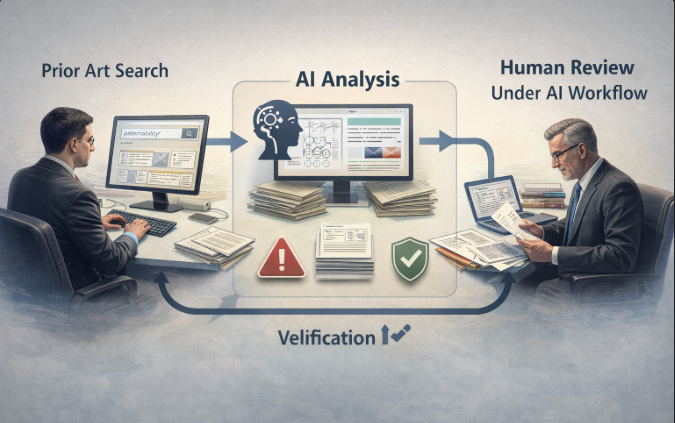
A DIY Approach: What Patent Professionals Can Do with Existing AI Tools
For individual practitioners, patent agents, and even business teams, the rise of accessible AI tools has opened up powerful new possibilities for conducting effective prior art searches without relying solely on enterprise platforms.
A strong starting point is to deconstruct the invention into its core technical features. Instead of working with a broad narrative description, AI can be used to extract structured elements such as components, functional relationships, and distinctions between essential and optional features. This structured representation becomes the backbone of a more intelligent search strategy.
From there, AI can be used to generate a wide range of semantic search queries. Rather than relying on a fixed set of keywords, users can prompt AI to produce alternative descriptions, synonyms, and functionally equivalent phrases. This expands the search space significantly and helps uncover prior art that would otherwise be missed using traditional keyword methods.
These AI-generated queries can then be combined with public patent databases such as Google Patents, Espacenet, and The Lens. Once relevant documents are identified, they can be fed back into AI systems for summarization, relevance ranking, and deeper analysis. This iterative loop-search, analyze, refine-allows for progressively better results.
Another powerful use of AI is in feature mapping. By comparing the extracted features of an invention against those found in prior art, AI can help generate early-stage claim charts that highlight overlaps and gaps. While not legally definitive, this provides a strong foundation for assessing novelty and identifying potential risks.
Example of AI-generated feature mapping table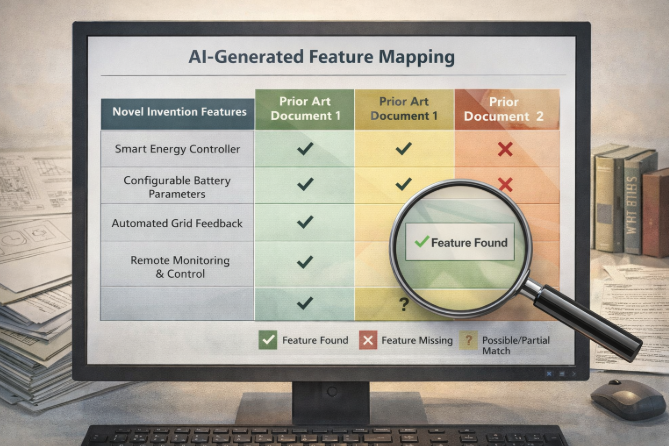
Multimodal capabilities further enhance this process. By uploading patent figures or technical diagrams, users can prompt AI to interpret structural elements and compare them to the invention’s features. This is particularly valuable in technical domains where visual representations carry as much weight as written descriptions.
At the core of this DIY approach is the principle of maintaining a human-in-the-loop workflow. AI should be used for discovery, expansion, and initial analysis, while human expertise remains essential for validation, interpretation, and legal judgment. The most effective workflows are iterative, with continuous refinement of both the search strategy and the evaluation of results.
Best Practices
To effectively utilize AI in prior art and patentability searches, practitioners should adopt a mindset that prioritizes features over keywords, always validates AI outputs against original sources, and leverages multiple tools to reduce blind spots. Search should be treated as an iterative process rather than a one-time task, and documentation should be maintained throughout to ensure defensibility and transparency.
The Road Ahead
AI is rapidly evolving toward deeper multimodal understanding, improved feature mapping, and early forms of automated claim analysis. However, it has not yet reached the point of replacing professional judgment. The practitioners who will benefit most are those who understand both the strengths and the limitations of AI-using it to augment their capabilities rather than replace them.
Conclusion
AI has transformed prior art and patentability search from a rigid, keyword-driven process into a dynamic, intelligence-driven workflow. For law firms, the challenge lies in integrating these tools responsibly within established legal practices. For individual practitioners and innovators, the opportunity lies in leveraging accessible AI tools to perform sophisticated searches that were previously out of reach.

Ultimately, the most effective approach is not AI alone, but a thoughtful combination of AI capabilities, structured workflows, and expert human judgment.
About the Author and Firm
This analysis is provided by Kama Thuo, PLLC, an engineering & technology law firm focused on patents, AI, and wireless telecom law. Colletar Nthambi is a versatile professional specializing in wireless engineering and paralegal practice. With strong technical expertise in telecommunications, she supports engineering and IP-related legal work, bridging the gap between wireless innovation and legal strategy.
Whether you are an inventor seeking to license your technology or a company navigating an IP dispute, our firm has the technical and legal expertise to protect your interests. Contact us to learn how we can help you at www.kthlaw.com/patents or explore our AI-powered legal services at https://www.kthlaw.com/ai.