- Details
- Category: Wireless Telecom Law
Auction 113 was the FCC’s first spectrum auction in approximately four years. Bidding began on June 2, 2026 and concluded on June 23 after 72 bidding rounds. Seventeen qualified bidders participated, and the auction generated more than $3.5 billion in gross winning bids for 200 AWS-3 licenses [1].
From Auction Completion to License Grants
Following the close of bidding, the FCC formally announced the Auction 113 results on June 26, 2026. Winning bidders were then required to complete the post-auction licensing process, including submitting long-form applications and satisfying payment requirements. According to the FCC, long-form applications were due July 13, 2026, and six applications were accepted for filing on August 11.
After further review, the Wireless Telecommunications Bureau determined that the applications covering the 199 licenses were complete and complied with FCC rules. The Commission also confirmed that it had received full payment for those licenses. The Bureau consequently granted the six applications and issued the 199 licenses on August 26.
The FCC’s August Public Notice covers 199 of the 200 licenses won in Auction 113. Accordingly, the August action should be described specifically as the grant of those 199 licenses rather than as the final licensing disposition of every license awarded in the auction [2].
What Spectrum Was Auctioned?
Auction 113 made available 200 licenses in the 1695-1710 MHz, 1755-1780 MHz, and 2155-2180 MHz bands (see other spectrum information). These licenses had been subject to bid defaults or withdrawals following the earlier 2014 AWS-3 auction and had remained in the FCC’s inventory.
The AWS-3 spectrum is important because it provides additional licensed mid-band capacity that can support commercial wireless broadband services. It builds on earlier Advanced Wireless Services allocations such as AWS-1, which includes spectrum used by LTE Band 4 in the 1710–1755 MHz and 2110–2155 MHz ranges. Returning AWS-3 licenses to commercial use gives successful bidders additional spectrum resources that may be incorporated into existing and future wireless networks. For additional technical background on AWS-1 and LTE Band 4, see RFWEL Wireless Device Information: LTE Band 4.
Broader Signal for the U.S. Spectrum Pipeline
Auction 113 is significant not only because of the AWS-3 licenses involved, but also because it marked the return of the FCC’s spectrum auction program after a four-year gap. The Wireless Infrastructure Association described the auction’s conclusion as an important step toward rebuilding a pipeline of commercially licensed spectrum and specifically pointed to the Upper C-Band auction as a near-term priority.
The FCC also directly connected Auction 113 with its preparations for the next major spectrum auction. When announcing the auction’s conclusion, the Commission said it was preparing for the forthcoming Upper C-Band auction and was on schedule to meet the congressional deadline to establish competitive bidding for at least 100 MHz of Upper C-Band spectrum by July 2027.
On June 30, 2026, the Wireless Infrastructure Association also welcomed the FCC’s announcement regarding plans to auction 160 MHz of Upper C-Band spectrum. WIA specifically cited the success of Auction 113 as evidence of continuing industry demand for additional commercial spectrum [3].
What Does This Mean for 5G?
For 5G networks, additional licensed mid-band spectrum can provide operators with greater flexibility to add capacity and support growing traffic demands. Auction 113 does not immediately change consumer wireless service nationwide, because the licenses cover different geographic areas and their practical effect will depend on how and when individual licensees deploy the spectrum.
The August 26 license grants nevertheless represent an important transition point. The auction is no longer simply a completed bidding process: the FCC has now formally authorized use of 199 of the licenses awarded through Auction 113.
What About 6G?
The immediate significance of AWS-3 spectrum is more closely associated with current and evolving 5G networks than with standalone 6G deployment. However, Auction 113 remains relevant to the broader 6G discussion because future wireless systems will depend on continued availability of licensed spectrum across multiple frequency ranges.
The larger policy issue is therefore the broader spectrum pipeline that follows Auction 113. The planned Upper C-Band auction and other future spectrum proceedings will help determine what additional mid-band resources may become available as U.S. wireless networks evolve beyond 5G.
What Comes Next?
For recipients of the 199 licenses granted on August 26, attention now shifts to compliance with the technical, construction, operating and other regulatory obligations applicable to AWS-3 licenses. The FCC specifically reminded licensees that they remain responsible for complying with all Commission orders, rules and policies governing the licenses.
At the broader policy level, attention is now moving toward the next phase of the FCC’s spectrum pipeline, particularly the Upper C-Band. Auction 113 demonstrated renewed demand for licensed spectrum and successfully returned previously idle AWS-3 licenses to the commercial licensing process. The August 2026 grant of 199 licenses marks the next stage in translating those auction results into spectrum that can ultimately be incorporated into wireless networks.
References:
[1] Auction 113 - AWS-3: Auction Data - Announcements
[2] Wireless Telecommunication Bureau Grants Auction 113 Licenses
[3] WIA Statement on FCC Announcement of Auctioning 160 MHz of Upper C-Band Spectrum
About the Author and Firm
This article is provided by Kama Thuo, PLLC, an engineering and technology law firm focused on wireless telecommunications, artificial intelligence, intellectual property, and emerging technology regulation. Brian Kibet is a multidisciplinary professional with experience spanning wireless engineering, legal research, and software development. His work focuses on the intersection of telecommunications, technology policy, and AI-driven automation, helping organizations navigate complex technical and regulatory challenges. Drawing on expertise in wireless systems, spectrum management, and advanced technologies, he analyzes developments shaping the future of connectivity, including 5G, 6G, satellite communications, and next-generation network infrastructure.
Learn more about regulatory insights and technical spectrum analyses here: Spectrum Licensing Practices or Contact us for more information.
- Details
- Category: Wireless Telecom Law
The restoration of auction authority, the launch of AWS-3 Auction 113 in 2026, and ongoing efforts to identify additional mid-band spectrum resources reflect a broader strategy to strengthen U.S. leadership in wireless communications. As demand for advanced 5G services continues to grow and planning for future 6G networks accelerates, policymakers are increasingly focused on ensuring that sufficient spectrum resources are available to support innovation, economic growth, and global competitiveness.
These developments build upon earlier spectrum initiatives, including the FCC’s 600 MHz Incentive Auction, while shifting attention toward the mid-band frequencies that are expected to play a central role in the next generation of wireless technologies.
The Legacy of the 600 MHz Auction
The FCC’s Incentive Auction, completed in 2017, was one of the most innovative spectrum auctions ever conducted. It repurposed broadcast television spectrum for mobile broadband use and made 70 MHz of low-band spectrum available for wireless services.
The auction helped expand LTE coverage nationwide and later became a cornerstone of low-band 5G deployments. Low-band spectrum around 600 MHz offers excellent propagation characteristics, enabling signals to travel long distances and penetrate buildings more effectively than higher-frequency bands.
As carriers deployed nationwide 5G networks, 600 MHz spectrum became particularly valuable for providing broad geographic coverage, especially in rural areas. However, while low-band spectrum excels at coverage, it cannot alone meet the growing demand for network capacity, ultra-low latency, and emerging AI-driven applications.
Why Mid-Band Spectrum Has Become the New Priority
Mid-band spectrum generally refers to frequencies between approximately 1 GHz and 7 GHz. These frequencies offer a balance between coverage and capacity, providing significantly greater throughput than low-band spectrum while maintaining practical coverage characteristics.
Federal policymakers have increasingly recognized that access to additional mid-band spectrum is necessary to maintain U.S. competitiveness in advanced wireless technologies. Congress, the FCC, and the National Telecommunications and Information Administration (NTIA) have all identified spectrum availability as a critical component of economic growth, national security, and technological leadership.
The demand for mid-band spectrum is expected to increase as wireless networks support increasingly data-intensive applications, including artificial intelligence, advanced manufacturing, autonomous systems, and next-generation communications platforms.
Restoration of FCC Spectrum Auction Authority
A major development occurred in 2025 when Congress restored the FCC’s spectrum auction authority after a period during which the agency lacked authority to conduct new auctions.
The legislation not only restored the FCC’s ability to auction spectrum licenses but also established a framework for identifying additional spectrum suitable for commercial wireless services. Congress directed federal agencies to evaluate spectrum resources and create a long-term pipeline of frequencies that could be made available for future wireless deployment.
The restoration of auction authority was widely viewed as a necessary step toward ensuring that the United States remains competitive in global wireless technology development. Spectrum auctions have historically played a significant role in expanding wireless infrastructure, promoting innovation, and supporting economic growth.
AWS-3 Auction 113 Marks the Return of Major Spectrum Auctions
The FCC’s AWS-3 Auction 113 represents one of the first significant spectrum auctions following the restoration of auction authority.
The auction involves Advanced Wireless Services (AWS) spectrum, which has long been recognized as valuable for commercial mobile broadband deployment. AWS spectrum supports a variety of wireless applications and is particularly useful for increasing network capacity in urban and suburban environments.
Auction 113 signals the beginning of a broader effort to expand spectrum availability for commercial wireless services. It also demonstrates the federal government’s renewed commitment to creating a predictable spectrum pipeline that allows carriers and investors to make long-term infrastructure decisions.
As wireless traffic continues to increase, additional AWS spectrum can help alleviate network congestion while supporting the continued expansion of 5G services nationwide.
Preparing for the Transition to 6G
Although commercial 6G deployment remains several years away, spectrum planning for 6G has already begun.
Researchers, standards organizations, federal agencies, and industry stakeholders are evaluating the spectrum resources that may be required to support future applications. Potential use cases include advanced artificial intelligence systems, digital twins, immersive communications, connected robotics, autonomous transportation systems, and large-scale industrial automation.
Future 6G networks are expected to demand greater flexibility, lower latency, higher reliability, and substantially increased capacity compared to current wireless systems. Achieving these goals will likely require access to additional mid-band spectrum and potentially higher-frequency resources beyond those currently used for commercial wireless services.
The spectrum decisions being made today will directly influence how effectively the United States can deploy and compete in future 6G ecosystems.
About the Author and Firm
This article is provided by Kama Thuo, PLLC, an engineering and technology law firm focused on wireless telecommunications, artificial intelligence, intellectual property, and emerging technology regulation. Brian Kibet is a multidisciplinary professional with experience spanning wireless engineering, legal research, and software development. His work focuses on the intersection of telecommunications, technology policy, and AI-driven automation, helping organizations navigate complex technical and regulatory challenges. Drawing on expertise in wireless systems, spectrum management, and advanced technologies, he analyzes developments shaping the future of connectivity, including 5G, 6G, satellite communications, and next-generation network infrastructure.
Learn more about regulatory insights and technical spectrum analyses here: Spectrum Licensing Practices or Contact us for more information.
- Details
- Category: Wireless Telecom Law
 |
On June 2, 2026, the Federal Communications Commission (FCC) launched Auction 113, marking the agency's first major spectrum auction since its auction authority was restored by Congress in 2025. The auction represents more than the sale of wireless spectrum licenses-it signals the return of a national spectrum strategy aimed at supporting advanced 5G deployment and laying the groundwork for future 6G networks. |
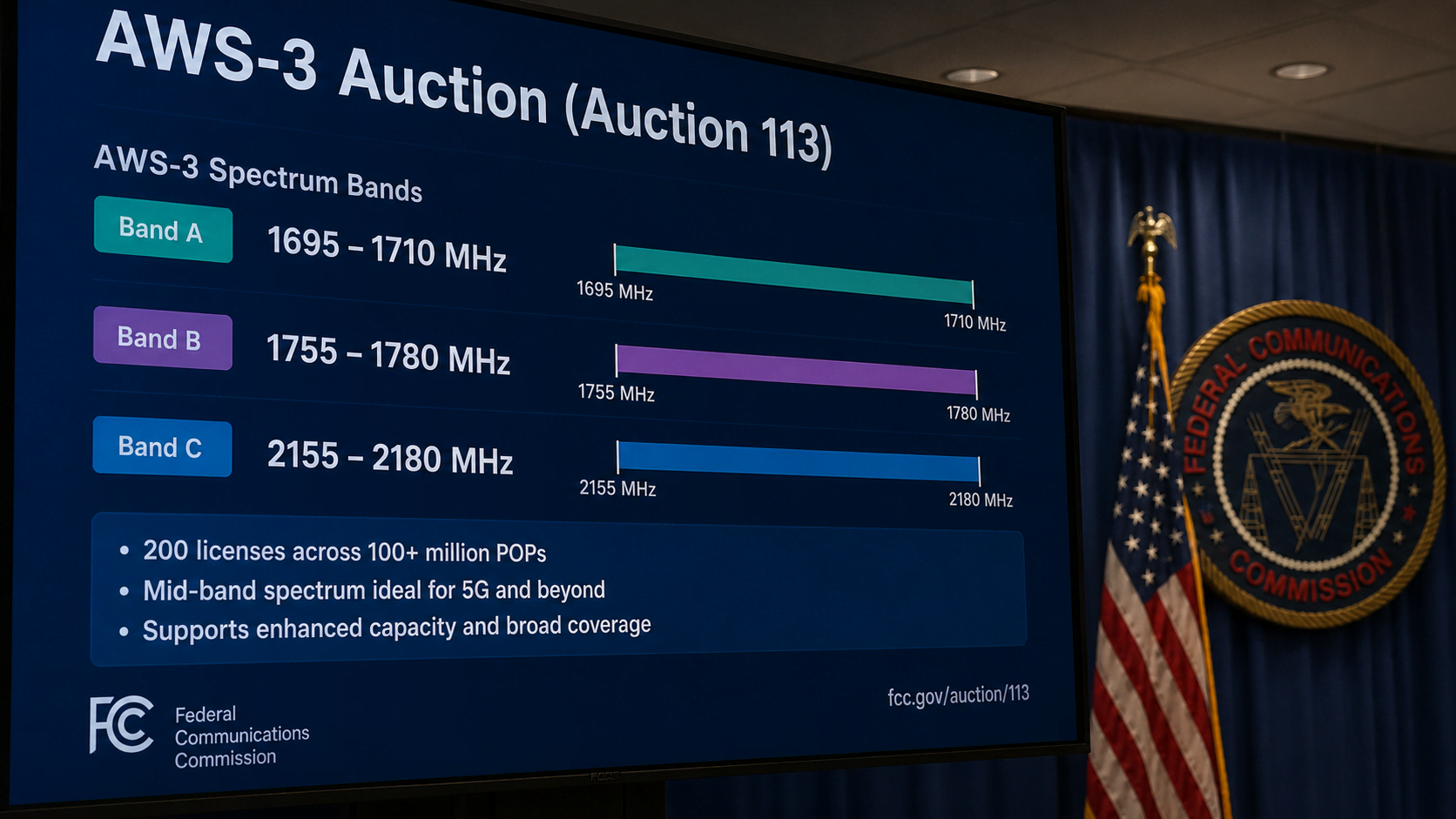
Auction 113 offers 200 Advanced Wireless Services (AWS-3) licenses in the 1695-1710 MHz, 1755-1780 MHz, and 2155-2180 MHz bands, bringing valuable mid-band spectrum back to market after years of regulatory and legal uncertainty. The auction is widely viewed as the first major milestone in rebuilding the United States' commercial spectrum pipeline.
Why Auction 113 Matters
The significance of Auction 113 extends far beyond the licenses being offered.
For more than two years, the FCC lacked general authority to conduct new spectrum auctions after its auction authority lapsed in 2023. During that period, policymakers, carriers, and industry stakeholders expressed concerns that the absence of new spectrum auctions could undermine U.S. competitiveness in wireless communications and delay the deployment of advanced broadband infrastructure.
Congress addressed these concerns in 2025 by restoring the FCC’s auction authority and authorizing the auction of AWS-3 licenses. Auction 113 therefore represents the practical implementation of that policy shift and the beginning of a renewed effort to expand spectrum resources available for commercial wireless services.
The Auction 113 includes licenses in the AWS-3 bands:
-
1695-1710 MHz
-
1755-1780 MHz
-
2155-2180 MHz
These frequencies are generally considered lower mid-band spectrum and are well suited for mobile broadband applications. Mid-band frequencies provide a balance between coverage and capacity, making them particularly valuable for modern 5G deployments.
The FCC has stated that Auction 113 will make 200 licenses available across markets covering more than 100 million people in the United States, including major metropolitan areas. The auction utilizes an ascending-clock auction format designed to promote transparent price discovery and efficient spectrum allocation.
Why Are These Licenses Available Again?
Many of the licenses offered in Auction 113 originated from the original AWS-3 auction conducted in 2014–2015.
Following that auction, certain winning bidders failed to satisfy payment obligations or lost eligibility for bidding credits, resulting in licenses being returned to FCC inventory. In particular, a substantial number of licenses were ultimately relinquished and remained unavailable for commercial deployment for years.
Auction 113 returns these spectrum assets to the marketplace, allowing carriers and other qualified bidders to put previously unused spectrum to productive use. According to FCC proceedings, many of the licenses offered in Auction 113 were previously awarded during the original AWS-3 auction but were later returned to FCC inventory after certain winning bidders failed to satisfy payment obligations [1].
Supporting National Security Objectives
Auction 113 also serves an important national security purpose.
Congress directed that proceeds from the auction be used to support the FCC’s Secure and Trusted Communications Networks Reimbursement Program, commonly known as the “Rip and Replace” program. The initiative helps telecommunications providers remove and replace equipment produced by companies deemed national security risks, including Huawei and ZTE.
The FCC has previously estimated that removing and replacing such equipment would require billions of dollars beyond previously appropriated funding levels. Auction proceeds are expected to help close part of that funding gap while simultaneously bringing valuable spectrum resources into commercial use.
Early Industry Interest
Auction 113 has attracted attention from traditional wireless carriers as well as newer participants exploring alternative communications models.
Industry observers have focused particularly on whether companies involved in satellite communications, direct-to-device services, and hybrid terrestrial-satellite networks may seek additional spectrum resources as connectivity models evolve.
Although the primary participants remain commercial wireless providers seeking additional network capacity, the auction reflects broader changes occurring across the communications industry as terrestrial and satellite systems increasingly converge.
Auction 113 and the Future Spectrum Pipeline
Perhaps the most important aspect of Auction 113 is what it represents for future spectrum policy.
The auction is the first major step in a broader effort by Congress, the FCC, and the National Telecommunications and Information Administration (NTIA) to expand spectrum availability for advanced wireless services. Policymakers have increasingly emphasized the need for additional mid-band spectrum to support growing demand for mobile broadband, artificial intelligence applications, industrial automation, and future wireless technologies.
Auction 113 demonstrates that the federal government is once again actively using competitive spectrum auctions as a mechanism for allocating valuable wireless resources and encouraging private-sector investment.
It also provides a preview of larger spectrum initiatives that may follow, including potential future auctions involving additional mid-band frequencies and portions of the Upper C-Band spectrum.
Implications for 6G
Although 6G remains in the research and standards-development phase, today's spectrum decisions will significantly influence future deployment options.
Many experts expect future 6G networks to require greater access to mid-band spectrum because of its ability to provide both wide-area coverage and high-capacity communications. Applications such as AI-native networks, digital twins, immersive communications, autonomous systems, and advanced industrial automation are expected to place increasing demands on wireless infrastructure.
By returning valuable AWS-3 spectrum to the marketplace and restarting the FCC’s auction program, Auction 113 helps establish the regulatory and spectrum foundation upon which future wireless generations will be built.
Conclusion
Auction 113 represents more than the return of AWS-3 licenses to the marketplace. It marks the FCC’s return to large-scale spectrum auctions following the restoration of auction authority and signals the beginning of a renewed national spectrum strategy.
The auction advances multiple policy objectives simultaneously: expanding spectrum availability for 5G services, supporting national security initiatives, encouraging private-sector investment, and helping prepare the United States for future 6G deployment.
As policymakers continue evaluating additional mid-band opportunities and future spectrum releases, Auction 113 will likely be remembered as the event that restarted the nation's commercial spectrum pipeline and set the stage for the next generation of wireless innovation.
References:
[1] US FCC advances wireless spectrum auction to fund removal of Chinese equipment.
About the Author and Firm
This article is provided by Kama Thuo, PLLC, an engineering and technology law firm focused on wireless telecommunications, artificial intelligence, intellectual property, and emerging technology regulation. Brian Kibet is a multidisciplinary professional with experience spanning wireless engineering, legal research, and software development. His work focuses on the intersection of telecommunications, technology policy, and AI-driven automation, helping organizations navigate complex technical and regulatory challenges. Drawing on expertise in wireless systems, spectrum management, and advanced technologies, he analyzes developments shaping the future of connectivity, including 5G, 6G, satellite communications, and next-generation network infrastructure.
Learn more about regulatory insights and technical spectrum analyses here: Spectrum Licensing Practices or Contact us for more information.
- Details
- Category: Wireless Telecom Law
In May 13, 2025 there was a new proposal in Congress that aims to auction 600 megahertz of federal spectrum, building on prior spectrum policy initiatives. The plan is for the FCC to auction at least 200 MHz of spectrum within three years of enactment of the law and auction the rest within six years. The legislation, structured through reconciliation, excludes key frequency ranges - specifically 3.1 - 3.45 GHz and 5.925 - 7.125 GHz - due to national security and federal agency use.
These bands are not idle. According to a September 2023 report, the Pentagon heavily utilizes the 3.1 - 3.45 GHz range for radars, weapons systems, satellite communications, and navigation operations. Additionally, there are plans for DoD to likely use this band for the Golden Dome missile defense system that Trump ordered back in January.
Similarly, the 6 GHz range (5.925–7.125 GHz) supports key applications governed under FCC Part 101 and is widely used for fixed wireless backhaul and public safety communications. See more on the 6 GHz band here.
While the bill doesn't pinpoint which specific spectrum blocks will be auctioned, Congress appears to give significant discretion to the Trump administration to locate the 600 MHz within the 1.3 GHz to 10 GHz range. This flexibility could open the door to repurposing underutilized mid-band spectrum - often seen as the “sweet spot” for 5G.
Why mid-band? High-band (mmWave) struggles with coverage and indoor penetration, and low-band spectrum, while expansive, requires larger antennas - a design constraint for today’s compact mobile devices. Mid-band spectrum balances coverage and capacity, making it the most efficient for nationwide 5G deployments. See various antennas for different applications.
Learn more about regulatory insights and technical spectrum analyses here: Spectrum Licensing Practices.
About the Author
Brian Kibet is a multidisciplinary professional with expertise in wireless engineering, paralegal practice, and software development. His work spans device compliance, regulatory frameworks, and intellectual property processes, leveraging AI and automation to streamline workflows while bridging the gap between technical innovation and legal strategy.
Kama Thuo, PLLC is a Wireless Telecommunications Law firm with expertise in wireless telecom legal issues and AI services. Contact us or visit https://www.kthlaw.com/wireless.
Additional technical details on these frequency bands are available from Rfwel Engineering’s Telecom Research group here.
- Details
- Category: Wireless Telecom Law
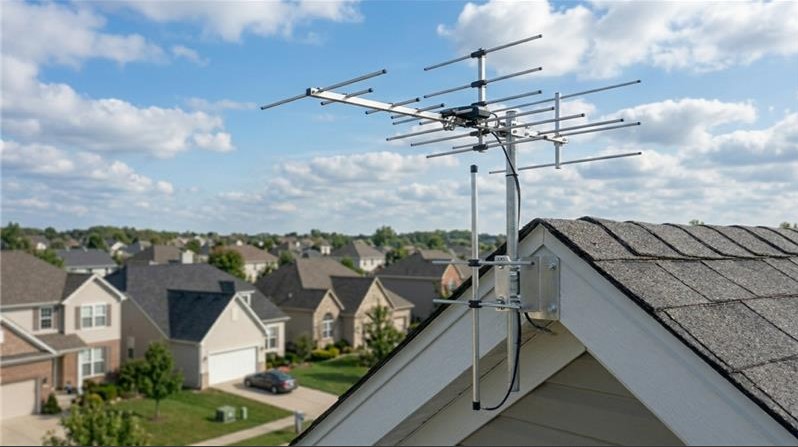
Homeowners' associations (HOAs) and condominium associations frequently impose private land use restrictions, known as covenants, conditions, and restrictions (CC&Rs), that regulate the installation of external antennas. While these restrictions are meant to maintain aesthetic consistency, they can conflict with laws that protect the rights of homeowners to install antennas for television and wireless broadband. However, no federal law currently prevents HOAs from imposing restrictions on amateur radio antennas, leaving many ham radio operators subject to private land use regulations. This legal gap has prompted legislative efforts to extend federal protections to amateur radio operators. This article explores the legal landscape governing external antennas, highlights the rights and limitations imposed by federal law, and provides guidance for homeowners and HOAs seeking to navigate this complex issue.
Federal Laws Governing External Antennas
OTARD: Protecting TV and Wireless Broadband Antennas
The Over-the-Air Reception Devices (OTARD) Rule (47 C.F.R. § 1.4000) was established by the Federal Communications Commission (FCC) to prohibit private land use restrictions that interfere with the installation, maintenance, or use of certain antennas. The rule applies to:
- Satellite dishes one meter or less in diameter.
- TV antennas designed to receive local broadcast signals.
- Fixed wireless broadband antennas for internet services.
Key Provisions:
- HOAs cannot prohibit the installation of these devices on property under the exclusive control of the homeowner (e.g., private balconies, patios, or backyards).
- HOAs may enforce reasonable restrictions for safety, structural integrity, or historic preservation, provided they do not increase costs, degrade performance, or delay installation.
- The rule does not apply to common areas owned by the HOA, such as shared rooftops.
PRB-1: Federal Limits on Local Zoning Laws for Amateur Radio Antennas
PRB-11 (47 C.F.R. § 97.15(b)) is an FCC regulation that preempts state and local zoning regulations from unreasonably restricting amateur radio antennas. It requires local governments to provide reasonable accommodation for ham radio antennas while allowing minimal regulation for health, safety, or aesthetics.
PRB-1 states:
"State and local regulations that involve placement, screening, or height of antennas based on health, safety, or aesthetic considerations must be crafted to reasonably accommodate amateur radio communications and to represent the minimum practicable regulation to accomplish the local authority's legitimate purpose."
While PRB-1 ensures that municipalities cannot outright ban ham radio antennas, it does not apply to private CC&Rs imposed by HOAs. This means that HOAs remain free to prohibit amateur radio antennas unless future legislation changes this.
Pending Legislation: S.3690 and H.R.4006
Recognizing the need for stronger federal protection for amateur radio operators in HOA communities, Congress introduced the Amateur Radio Emergency Preparedness Act (S.3690 and H.R.4006). If enacted, these bills would:
- Prohibit HOAs from imposing blanket bans on amateur radio antennas.
- Require HOAs to permit effective outdoor antennas for amateur radio use.
- Allow HOAs to enforce reasonable written rules on the height, placement, and aesthetics of antennas, similar to PRB-1 protections at the municipal level.
This legislation aims to bridge the gap left by PRB-1, ensuring that amateur radio operators can provide critical emergency communications without facing unreasonable HOA restrictions.
Past Efforts: The Amateur Radio Parity Act of 2019
The Amateur Radio Parity Act of 2019 (H.R. 466) attempted to extend PRB-1 protections to private land use restrictions. It sought to:
- Require HOAs to reasonably accommodate amateur radio antennas.
- Allow HOAs to impose minimum practicable restrictions for aesthetic and community interests.
- Maintain HOA authority over common areas while permitting antennas on property under a homeowner’s exclusive control.
While the bill did not pass, it underscored the federal interest in protecting amateur radio operators and laid the foundation for current legislative efforts.
Balancing HOA Interests with Amateur Radio Needs
The HOA Perspective: Why Restrictions Exist
HOAs argue that external antenna restrictions serve to:
- Maintain aesthetic uniformity in the community.
- Protect property values by preventing unsightly installations.
- Minimize potential safety concerns, such as antenna collapses in storms.
Many homeowners willingly choose HOA communities for these regulations, which contribute to a clean, well-maintained environment.
The Amateur Radio Perspective: Why Antennas Matter
Amateur radio operators contend that external antennas are essential for effective communication, particularly for:
- Emergency response and disaster relief when other networks fail.
- Search and rescue operations in remote areas.
- Technical experimentation and education in wireless communications.
Many ham radio operators volunteer their expertise in disaster scenarios, and overly restrictive HOA policies can hinder these critical services.
How to Navigate HOA Restrictions on Antennas
If you are facing an HOA restriction on an external amateur radio antenna, consider these steps:
- Review Your HOA’s Covenants, Conditions, and Restrictions (CC&Rs) – Understand whether the restrictions are absolute or allow exemptions.
- Engage with the HOA Board – Educate them on the public service benefits of amateur radio and propose reasonable accommodations.
- Suggest Alternative Antenna Designs – Some HOAs may allow stealth antennas, flagpole antennas, or attic-mounted solutions.
- Reference Federal Law and Pending Legislation – While PRB-1 does not apply, mentioning S.3690/H.R.4006 may encourage the board to adopt fairer rules.
- Seek Legal Guidance – If the HOA refuses to cooperate, consult an attorney to explore legal options and negotiations.
HOA restrictions on external antennas remain a contentious issue, with strong arguments on both sides. While OTARD protects TV and broadband antennas, amateur radio operators lack similar federal protections, leaving them vulnerable to HOA prohibitions. Pending legislation (S.3690 and H.R.4006) aims to change this, ensuring that ham radio operators can continue to provide critical emergency communications without unnecessary restrictions.
If you are an HOA seeking to craft reasonable antenna policies, or a homeowner facing unfair restrictions, legal guidance can help you navigate this complex issue.
About the Author
Roque Thuo (KF7RCQ) is a licensed attorney (Arizona, California, and USPTO) and a licensed professional electrical engineer (Arizona) specializing in wireless telecommunications law. His dual expertise in legal and technical aspects of antenna installation, RF compliance, and signal propagation analysis allows him to provide comprehensive counsel for homeowners, amateur radio operators, and HOAs. If you need assistance navigating HOA antenna restrictions or crafting legally sound CC&Rs, contact Roque for expert legal and engineering guidance today.
Roque also serves as General Counsel to an Arizona RF engineering firm Rfwel Engineering, LLC. Check them out for engineering support and amateur radio antennas and wireless infrastructure equipment.