 |
On June 2, 2026, the Federal Communications Commission (FCC) launched Auction 113, marking the agency's first major spectrum auction since its auction authority was restored by Congress in 2025. The auction represents more than the sale of wireless spectrum licenses-it signals the return of a national spectrum strategy aimed at supporting advanced 5G deployment and laying the groundwork for future 6G networks. |
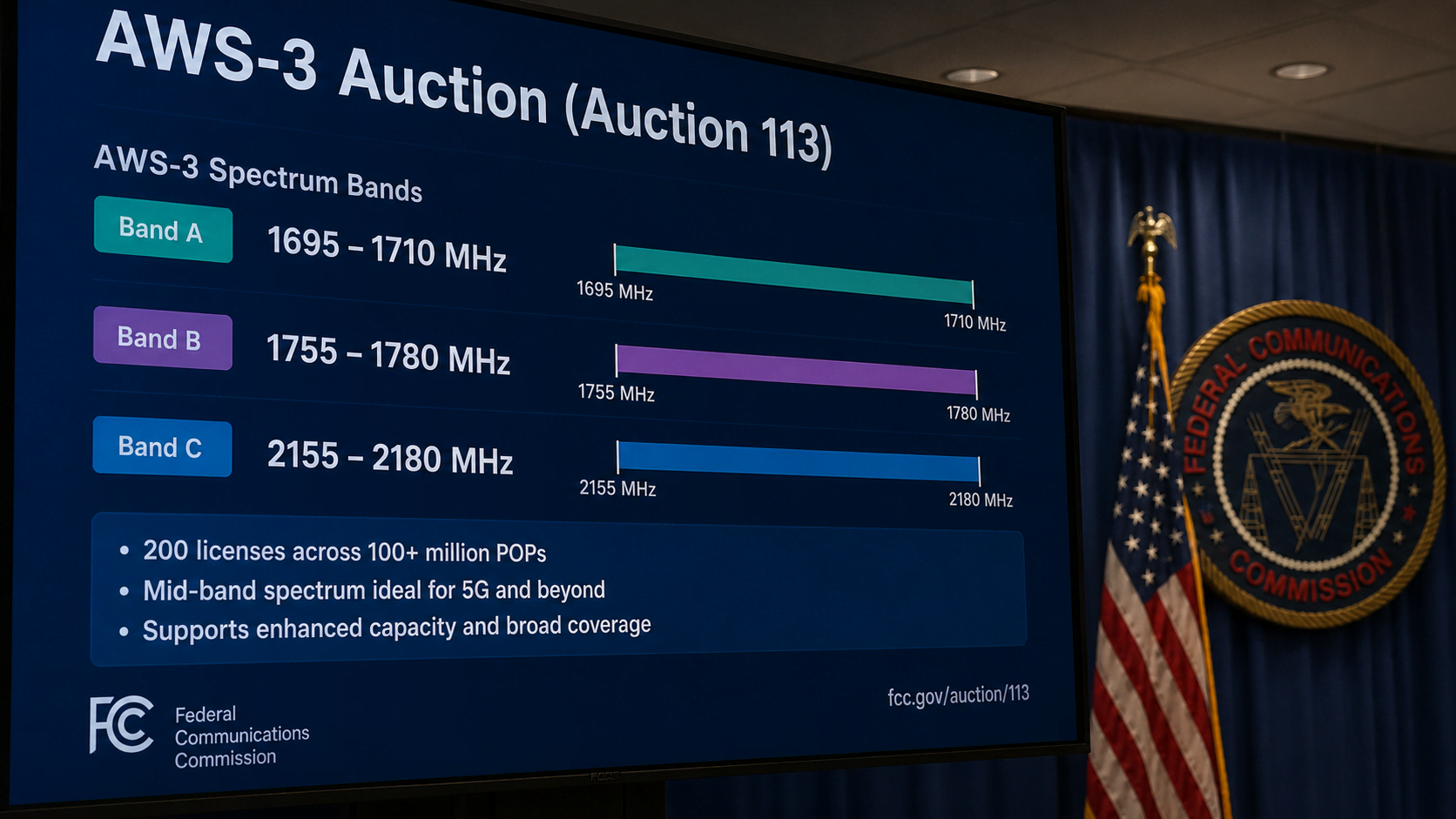
Auction 113 offers 200 Advanced Wireless Services (AWS-3) licenses in the 1695-1710 MHz, 1755-1780 MHz, and 2155-2180 MHz bands, bringing valuable mid-band spectrum back to market after years of regulatory and legal uncertainty. The auction is widely viewed as the first major milestone in rebuilding the United States' commercial spectrum pipeline.
Why Auction 113 Matters
The significance of Auction 113 extends far beyond the licenses being offered.
For more than two years, the FCC lacked general authority to conduct new spectrum auctions after its auction authority lapsed in 2023. During that period, policymakers, carriers, and industry stakeholders expressed concerns that the absence of new spectrum auctions could undermine U.S. competitiveness in wireless communications and delay the deployment of advanced broadband infrastructure.
Congress addressed these concerns in 2025 by restoring the FCC’s auction authority and authorizing the auction of AWS-3 licenses. Auction 113 therefore represents the practical implementation of that policy shift and the beginning of a renewed effort to expand spectrum resources available for commercial wireless services.
The Auction 113 includes licenses in the AWS-3 bands:
-
1695-1710 MHz
-
1755-1780 MHz
-
2155-2180 MHz
These frequencies are generally considered lower mid-band spectrum and are well suited for mobile broadband applications. Mid-band frequencies provide a balance between coverage and capacity, making them particularly valuable for modern 5G deployments.
The FCC has stated that Auction 113 will make 200 licenses available across markets covering more than 100 million people in the United States, including major metropolitan areas. The auction utilizes an ascending-clock auction format designed to promote transparent price discovery and efficient spectrum allocation.
Why Are These Licenses Available Again?
Many of the licenses offered in Auction 113 originated from the original AWS-3 auction conducted in 2014–2015.
Following that auction, certain winning bidders failed to satisfy payment obligations or lost eligibility for bidding credits, resulting in licenses being returned to FCC inventory. In particular, a substantial number of licenses were ultimately relinquished and remained unavailable for commercial deployment for years.
Auction 113 returns these spectrum assets to the marketplace, allowing carriers and other qualified bidders to put previously unused spectrum to productive use. According to FCC proceedings, many of the licenses offered in Auction 113 were previously awarded during the original AWS-3 auction but were later returned to FCC inventory after certain winning bidders failed to satisfy payment obligations [1].
Supporting National Security Objectives
Auction 113 also serves an important national security purpose.
Congress directed that proceeds from the auction be used to support the FCC’s Secure and Trusted Communications Networks Reimbursement Program, commonly known as the “Rip and Replace” program. The initiative helps telecommunications providers remove and replace equipment produced by companies deemed national security risks, including Huawei and ZTE.
The FCC has previously estimated that removing and replacing such equipment would require billions of dollars beyond previously appropriated funding levels. Auction proceeds are expected to help close part of that funding gap while simultaneously bringing valuable spectrum resources into commercial use.
Early Industry Interest
Auction 113 has attracted attention from traditional wireless carriers as well as newer participants exploring alternative communications models.
Industry observers have focused particularly on whether companies involved in satellite communications, direct-to-device services, and hybrid terrestrial-satellite networks may seek additional spectrum resources as connectivity models evolve.
Although the primary participants remain commercial wireless providers seeking additional network capacity, the auction reflects broader changes occurring across the communications industry as terrestrial and satellite systems increasingly converge.
Auction 113 and the Future Spectrum Pipeline
Perhaps the most important aspect of Auction 113 is what it represents for future spectrum policy.
The auction is the first major step in a broader effort by Congress, the FCC, and the National Telecommunications and Information Administration (NTIA) to expand spectrum availability for advanced wireless services. Policymakers have increasingly emphasized the need for additional mid-band spectrum to support growing demand for mobile broadband, artificial intelligence applications, industrial automation, and future wireless technologies.
Auction 113 demonstrates that the federal government is once again actively using competitive spectrum auctions as a mechanism for allocating valuable wireless resources and encouraging private-sector investment.
It also provides a preview of larger spectrum initiatives that may follow, including potential future auctions involving additional mid-band frequencies and portions of the Upper C-Band spectrum.
Implications for 6G
Although 6G remains in the research and standards-development phase, today's spectrum decisions will significantly influence future deployment options.
Many experts expect future 6G networks to require greater access to mid-band spectrum because of its ability to provide both wide-area coverage and high-capacity communications. Applications such as AI-native networks, digital twins, immersive communications, autonomous systems, and advanced industrial automation are expected to place increasing demands on wireless infrastructure.
By returning valuable AWS-3 spectrum to the marketplace and restarting the FCC’s auction program, Auction 113 helps establish the regulatory and spectrum foundation upon which future wireless generations will be built.
Conclusion
Auction 113 represents more than the return of AWS-3 licenses to the marketplace. It marks the FCC’s return to large-scale spectrum auctions following the restoration of auction authority and signals the beginning of a renewed national spectrum strategy.
The auction advances multiple policy objectives simultaneously: expanding spectrum availability for 5G services, supporting national security initiatives, encouraging private-sector investment, and helping prepare the United States for future 6G deployment.
As policymakers continue evaluating additional mid-band opportunities and future spectrum releases, Auction 113 will likely be remembered as the event that restarted the nation's commercial spectrum pipeline and set the stage for the next generation of wireless innovation.
References:
[1] US FCC advances wireless spectrum auction to fund removal of Chinese equipment.
About the Author and Firm
This article is provided by Kama Thuo, PLLC, an engineering and technology law firm focused on wireless telecommunications, artificial intelligence, intellectual property, and emerging technology regulation. Brian Kibet is a multidisciplinary professional with experience spanning wireless engineering, legal research, and software development. His work focuses on the intersection of telecommunications, technology policy, and AI-driven automation, helping organizations navigate complex technical and regulatory challenges. Drawing on expertise in wireless systems, spectrum management, and advanced technologies, he analyzes developments shaping the future of connectivity, including 5G, 6G, satellite communications, and next-generation network infrastructure.
Learn more about regulatory insights and technical spectrum analyses here: Spectrum Licensing Practices or Contact us for more information.